


A Mountain, Some Mead, and the Quietest Christmas Eve in London
Updated: 1 day ago
I left the last post with a bruise from a van bumper and a promise about Wales, and then four months went by, which is about standard. The bruise has gone. Wales happened. So did a good deal of not very much, which has been the texture of this autumn for everybody, and which I’m going to write down anyway, on the grounds that the alternative is forgetting any of it occurred.
Pen y Fan
We drove out on the Friday night of the bank holiday, a group of us, and checked into a hotel on a golf course — not a sentence I had ever expected to write, and perfectly comfortable, in the way of hotels whose main clientele has a tee time and would like breakfast before it.
Saturday morning was cold. Properly cold, for August, with a wind that had clearly come some distance to be there. We went up by the old Roman road — whether the Romans had anything to do with it is, I gather, disputed, but somebody built it and they built it straight — which climbs steadily towards a gap in the ridge and then hands you over to the path proper, where hundreds of small stone steps have been cut and set into the hillside. I spent a good part of the climb thinking about those steps. Every one of them has been pitched by hand and bedded on edge, by people who carried the stone up there first. It is, quite literally, a construction project halfway up a mountain with no site access, and nobody walking on it gives it a second thought, which is how you know it was done well.
The summit was the windiest place I have stood in years. People were having their photograph taken at the cairn at a lean of about fifteen degrees, hoods snapping. And then, while we were standing about getting our breath back, a glider came up over the lip of the ridge. No engine, no sound at all above the wind. He was working the updraught along the rim of the summit, back and forth, close enough that you could see his head turn, rising on the same air that was trying to remove the rest of us from the mountain. He must have made six or seven passes. Everybody on the top simply stopped and watched him. I have no idea how much skill it takes to sail an aircraft along the edge of a mountain in that wind, but I’d guess it is a great deal, and he made it look like something he was doing to pass the time.
I sent the video to Gemma. She replied, some hours later, “ok that is actually cool,” which I have banked.
Coming down is where it gets you. By the bottom my calves had opinions, and my hamstrings — which last lodged a formal complaint at a sports day in 2016 — reopened the file.
Lunch was at a pub, where the local mead was on the board and it seemed rude not to. I can report that mead tastes of honey and good intentions, and that one glass of it, after a morning like that, made the room tilt in a way I normally associate with considerably more effort.
On the way back to the hotel we stopped near Trefechan to walk out across the Pontsarn Viaduct — seven tall limestone arches over a wooded gorge, built in the 1860s to carry the Brecon and Merthyr line and now carrying cyclists, dog walkers, and people like us peering over the parapet. Then Cyfarthfa Castle, which is what an ironmaster builds himself when the iron is going well: battlements, a lake, and a view down over the works that paid for it.
Waterfall Country
Sunday was Waterfall Country — Sgwd yr Eira and its neighbours, from one of the main car parks just outside Pontneddfechan. We did a loop, several hours of it, and a fair amount of that was bog. Not metaphorical bog. The kind that takes a boot to the ankle and considers keeping it. But the falls earn every step: one after another through the woods, each arranged differently from the last, and loud enough that conversation stops of its own accord, which in our group is not nothing. Sgwd yr Eira is the one you can walk behind, and we did, single file along a wet ledge with the whole river coming down a foot from your shoulder. You come out the other side soaked and grinning like a ten-year-old. There is no dignified way to do it and nobody tries.
And the weather held. All weekend, in Wales, over a bank holiday. We drove home with aching legs and the distinct feeling of having got away with something.
Buenos Aires, Upstairs
Gemma was supposed to be spending this year in Buenos Aires. She had settled on it over Madrid some time in the spring, with the finality she brings to a decision once it’s made, and she had a university place and most of a plan. Then Argentina shut its borders in March and has not reopened them.
Exeter’s answer is something called a virtual year abroad, which means that my daughter’s year in South America is taking place in our study, on a laptop, on Buenos Aires time: seminars that start as Richard and I are thinking about bed, conducted in a Spanish that comes down through the ceiling a little faster and more sure of itself every week. She has not complained. That is not the same as not minding, and I know the difference. When the email came she read it twice, said “okay,” and went for a run. She says she’ll go anyway, afterwards, under her own steam, and I have no reason to doubt her.
In the meantime there are three of us in this house again, for a year none of us planned. I’m aware that I am getting something out of that which she is paying for.
September, Mostly Outdoors
September was a run of small outings, the sort that would once have been unremarkable and currently feel like events.
A Saturday out in Essex with friends, to Burnham-on-Crouch: lunch at the marina, and then what I can only describe as a pub crawl conducted at walking pace along the river, in sunshine, by people old enough to know better and to do it anyway. It was a long day. The journey home was warm and pleasant and I attribute this largely to the sauvignon.
A midweek dinner with Richard at the Hunter S, up towards Dalston, which he has wanted to visit for longer than I’ve understood why. It is a pub named after Hunter S. Thompson and decorated accordingly: low light, a great deal of taxidermy looking down at your dinner, and a general sense that the building has seen things. The food was good. Richard was delighted with all of it, and returned from the gents with a series of photographs of what is hung on the walls in there, which he describes as artistic and I would describe as something else. He has asked me to post them. Richard does not read this blog, so I’d note for the record that this is the first editorial request he has ever made of it, and I am declining.
One morning mid-month I took the bike up on an early train and met a colleague for a ride — loops of Mayfair while it was still half asleep, then laps of Regent’s Park, which at that hour belongs to people in matching kit travelling in formation. I am not in matching kit and I travel in no formation, but nobody seemed to mind. The roads are still so much quieter than they were, and I know what that quiet has cost, and I have loved riding in it all the same. There were banners up around Mayfair thanking the NHS. I read every one I passed.
And at the end of the month, a Saturday wandering Shoreditch and Whitechapel to see what the street artists have been up to — the walk I did with Gemma two winters ago, this time with Richard, who looks at a three-storey mural the way he looks at everything, which is thoroughly, with his hands behind his back, and without comment until about forty minutes later. (“The bird was good.” It was.) Half the walls had changed since I was last there, which is rather the point of them. We ended up at Boxpark for dinner, eating out of cardboard boxes at a bench, and I have had many worse Saturday nights in restaurants with tablecloths. The flat white on the way round was fine. You know my position.
Indoor Sports
In late October work organised an evening of shuffleboard, at one of those half-indoor, half-outdoor places that have done rather well out of this year, and which I can now recommend to anyone who has to arrange these things. It requires almost no physical effort, it can be played holding a drink, and it rewards a sort of low cunning rather than youth. Compare the alternatives. I have done the darts one, which gets loud. I have done the axe-throwing one, which I spent mentally drafting the incident report for. Shuffleboard asks only that you slide a puck down a table and mind your own business. I didn’t win. The cocktails were delightful, and I suspect the two facts are connected.
On the last night of October Richard and I had dinner at the Gun in Spitalfields with the couple from next door, who over the course of this year have gone from people we nodded to over the recycling to people who have a key. As it turned out, the Prime Minister had chosen the same evening to announce a second national lockdown, and then kept the country waiting for him for most of the afternoon, so the four of us ate with a phone propped against the pepper grinder. We ordered a bottle of merlot while we waited for him and another to discuss what he’d said. It was too much merlot. Richard’s summary, on the walk to the station, was “Well. That’s November.”
November, accordingly, was small. The best of it was a Friday afternoon with Serena at St Katharine Docks — takeaway coffees, that being what’s currently on offer, held in gloves at the water’s edge like two women waiting for a ferry — and then a long walk back along the river as it got dark, which in late November is about ten past four, with the bridges lit and almost nobody about. It’s a good spot. I’d somehow never stopped there in all my years of walking past it. Richard, who works from home on Fridays, was waiting at the station to walk me back. He doesn’t make anything of it. I noticed I was looking for him before the train had stopped.
Two Building Sites and a Blank Look
Work has carried on in its mask and its hi-vis. In early December I went up to our site in north-west London on a morning cold enough to make a clipboard painful, to look at the early groundworks there, including the start of a pavilion I’d had a hand in. Groundworks are nobody’s idea of a photograph — it’s mud, concrete and men pointing at mud and concrete — but there is nothing like standing at the edge of a hole and seeing that something you spent months arguing about in meeting rooms has become a thing with a bottom to it.
Then, the week before Christmas, a group of us went over to City Island, out east where the Lea loops round before it meets the Thames, to look at how another developer’s scheme is being put together — a great deal of it precast and prefabricated elsewhere and brought in to be assembled, rather than built wet on site the traditional way. All of this with a view straight across the water to the O2, which did its best to be distracting.
What I actually came away thinking about was cores. The core of a tower — lifts, stairs, risers, the concrete spine — traditionally goes up by slip form: a rig that climbs slowly and continuously while the concrete is poured beneath it, so the core races ahead and the floors follow it up. The alternative that one of the big contractors has come up with is, in effect, a factory that sits on top of the building: a whole enclosed working floor, roof and walls and gantry cranes, in which a storey gets built in the dry, after which the entire factory jacks itself up a level and does it again. A building site that climbs its own building. I think it’s one of the cleverest things I have seen in this industry, and I think the next ten years of British housebuilding will have a great deal more of the factory about it than the last hundred.
I explained all of this over dinner, at some length, with gestures. Richard wore the expression he uses on long-haul flights. Gemma waited until I’d finished and said, “So it’s a lift. For a building site.” That is wrong, and also, annoyingly, not entirely wrong. It was at this point I understood that what now genuinely excites me is of almost no interest to the two people I most want to tell about it. Their loss.
Christmas
We had next door round for Christmas Eve and Christmas Day — our bubble, in the language of the year — which was both stressful and lovely in roughly the proportions Christmas always is, just with fewer people to distribute it across. I cooked. Richard managed the drinks, which since the brewing group took over the shed is a larger portfolio than it used to be.
After dinner on Christmas Eve, somebody — it may have been me — said we should go and look at the lights. Gemma was invited and declined, on the grounds that it was freezing and we were being embarrassing. Both true. So the four of us went: train into town, hire bikes, and a slow, freezing loop under the angels on Regent Street and the whole length of Carnaby Street, at about ten at night, with no traffic, no shoppers, and the lights all on for nobody. Richard on a hire bike in a good wool coat, going carefully round Piccadilly Circus with his scarf tucked in, is a picture I’ll be keeping. My hands stopped working at around Oxford Circus. I would do it again tomorrow. If you live in London and have nobody small to get to bed, I can’t think of a better use of a Christmas Eve, and I hope it’s never this easy again.
Christmas Day was bright and cold and blue from beginning to end.
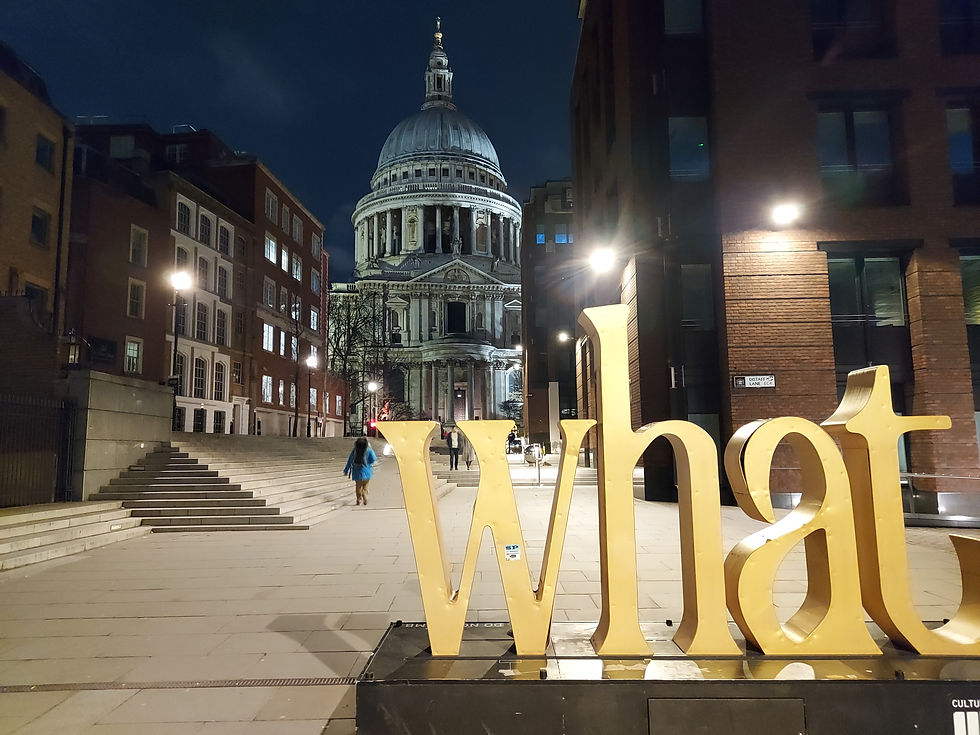
The days since have been quiet ones. A couple of evenings ago we walked through the City after dark — Leadenhall Market with its lights on and not a soul in it, every shutter down, our footsteps coming back at us off the painted ironwork. I have only ever known that market at lunchtime, shoulder to shoulder with men in gilets. I’m not sure I had ever actually heard it before.
Next year I would like, very much, not to be able to.


Comments