


How Not To Spend A Romantic Holiday You Booked Six Months Too Early
- Sep 10, 2017
- 10 min read
Updated: 18 hours ago
I have been back from Croatia for two days. The tan is fading, the cuts on my shin are scabbing, and I am sitting on my friends’ couch in Hammersmith trying to work out the kindest possible way to write down what was — by some considerable distance — the worst holiday of my life.
A bit of context, because the post will not make sense without it: Josh and I split up in June. I will write properly about that another time, because it deserves more than a paragraph and I am not yet up to the longer version. The shorter version is that we split, that I had no money to move out immediately, and that we spent the next two months living together in our Tooting flat as exes — sleeping in the same bed, sharing the same kitchen, mostly behaving like adults. I helped him move out the week before Croatia. I packed up my own room into boxes the day after, threw myself on the mercy of Connor and Kenji’s couch in Hammersmith, and got into a 5am taxi to Stansted three days later for an eight-day Mediterranean sailing trip with my ex, our shared friend group, and twelve total strangers.
This was a trip we had booked six months earlier, in the spring, when we were still a couple and the future looked like the future. By the time we boarded the flight, the future looked like a woman on a borrowed couch in Hammersmith, weighing whether she could afford to break the lease on a holiday she had paid for.
I went. I should not have gone. But I also could not afford to lose what I’d paid in, and some part of me believed that I could rise above it. Reader, I could not.
The Boats
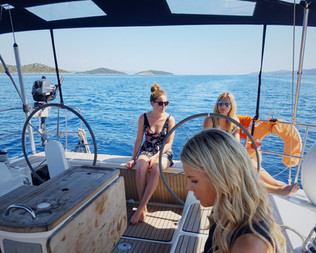
For anyone who hasn’t done a Croatian sailing flotilla — the format is genuinely lovely, in principle. You fly into Split. You meet your boat. Your boat is one of about seven or eight in a small fleet, organised by a tour company, that sails together up and down the Dalmatian coast for a week — Brač, Hvar, Vis, Stari Grad, back to Split. There’s a lead boat with the skipper-in-chief who briefs everyone in the morning. The boats sail loosely in convoy through the day, anchor together at the night’s stop, raft up at dinner, and disperse to whichever bar or beach club has been suggested for that evening. About twenty people across the fleet in total. You start the week as strangers; you end it knowing each other’s mothers’ maiden names.
Our boat was four of our group plus me — Josh, Dani, Kurt, and Bobby — plus a few others who had come on as the spare bunks. Total strangers when we boarded. Probably nicer than us.
Day One: The Cabin
The first thing that happened, before we’d even cast off, was the cabin assignment.
The booking — made in a different lifetime, when Josh and I were still us — had us in a shared cabin together. I had assumed, naively, that this would be quietly resolved. We had been sleeping in the same bed for the previous two months without incident. The booking pre-dated the breakup; the cabin was just a cabin; we were both adults; surely we could ask the skipper, on the quiet, to swap us into separate single bunks and move on. That had been my read of where we were.
It was not, it turned out, where we were. Something had shifted in Josh in the three weeks since he’d moved out — I had noticed it on a couple of phone calls in the run-up, but I had told myself I was reading too much into the tone. I had not been reading too much into the tone.
Josh did not consider the cabin question fine. Josh, in front of the rest of our group and three strangers we had not yet introduced ourselves to, announced — with a clarity I will remember for the rest of my life — that there was “no fucking way he was sharing a room with me, you cunt.”
I stood there. I did not say anything. The strangers stood there too. The skipper, an unflappable Croatian man in his fifties who I think had seen several variations of this scene before, made calm sympathetic noises and quietly reorganised the boat. I was put in with Bobby. Josh got the cabin he’d wanted. Dani and Kurt looked, as they had been looking since the breakup, like a jury.
This was minute fifteen of the holiday. It set the temperature for the next eight days.
The Pattern
The pattern, once established, did not really change. Josh and I would interact only when geography forced it — at the dinner table, on a tender boat, in a bar where there was no other table free. He was cold, then sharp, then cutting. The cutting remarks were occasionally landed in front of the strangers, who developed a polite habit of looking briefly at their drinks. I would attempt, the first few times, to push back. Each time I did, Dani or Kurt would intervene to point out that whatever I’d said was rude, and inappropriate, and that I was making the situation worse. Josh’s behaviour was treated as a permitted response to a long grievance. Mine was treated as an active disturbance.
On the third morning, Dani — generally the more measured of the two — pulled me aside on the deck, looked me directly in the face, and told me that she would fucking kill me if I ruined her holiday by causing a scene.
I should mention that Dani is one of my oldest friends in this country. We have known each other since intermediate school. She let me sleep on her couch for three months when I first landed in London. We have lived together off and on for the better part of three years. I did not know quite what to do with the sentence. I went to my cabin and lay on the bunk for half an hour, until I could trust my face again, and then I came back up on deck and said nothing.
Michelle and Adam had also come on the trip — Michelle being one of my closest friends in the world, Adam her partner. By the third day, even they had absorbed the group temperature, and were treating me with the kind of careful neutrality that people use when they have decided, on balance, that you are the problem. I had received, on the bus from the airport, a series of messages from Michelle that I am not going to type out here. Suffice it to say that the takeaway was: you brought this on yourself, you came on the trip anyway, and you are now actively ruining it for everyone else.
I would describe the loneliness of the next five days as the most acute loneliness I have experienced as an adult. Surrounded by people who had been my closest since arriving in London, on a boat, in some of the most beautiful water in Europe, and not having a single one of them on my side.
The strangers, to their credit, were kind. The Belgian couple on the next cabin asked me twice, gently, if I was alright. I lied to them.
What Was Beautiful Anyway
The thing that saved me, and I want to be honest about this because I am not yet at a stage in my life where I can write a post that is only a complaint, is that Croatia is properly, indecently beautiful. Not just photogenic. Beautiful in a way that gets into your chest before you’ve worked out what you’re looking at.
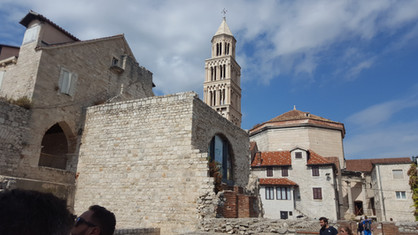
We started in Split, with its travertine streets and the Diocletian’s Palace tucked into the city like a Roman fossil with cafés in it. I wandered the old town that first morning before boarding, with my camera, by myself, and I took some of the best photographs I have taken in my life — not because I was technically on form but because I was so wound up that I noticed every detail twice. The light off the limestone. The way the locals moved through the palace ruins as if the ruins were a normal commute, which to them I suppose they are.
Bol, on Brač, is the postcard image — the Zlatni Rat beach, that tongue of white pebble curling into water that is so clear and so blue that the first time you see it you forget for a moment to take a photograph. We spent an afternoon there. I swam out alone, away from the group, and floated on my back and looked at the sky, and for thirty minutes I was happy in the basic biological way that warm Mediterranean water makes a person happy. Then I swam back to the boat and the temperature dropped about twelve degrees.
Milna is a small harbour town on the western tip of Brač, the kind of place that exists at a pace I could not entirely process — old men playing cards outside a café, a bakery, a single restaurant doing one menu, the sound of small fishing boats unloading. I had a coffee on the harbourfront the morning we were there and watched the boats come in. Nobody on the trip was awake yet. It was the best half-hour of the week.
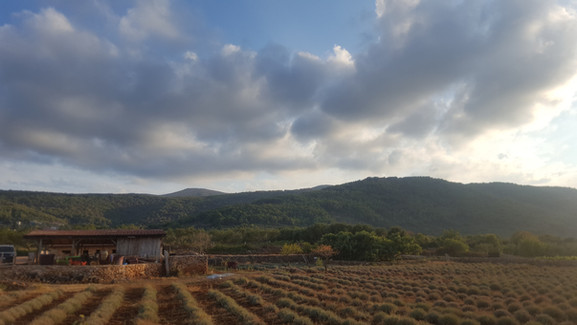
Vis has a strangeness to it that I loved — it’s the furthest island out, was a Yugoslav military base for decades and so was closed to tourism until the nineties, and you can still feel the reserve of that. The town wraps around a deep harbour. There are vineyards on the hills behind it. The food was better than anywhere else we ate, by a margin. Stari Grad on Hvar is older than almost anywhere else has any right to be — settled in 384 BC by the Greeks, still inhabited continuously since, with a cobbled main square that holds the centuries lightly.
And Hvar town itself, our last island stop, is its own creature. The old town is gorgeous in the day, all narrow lanes and cathedral squares. The nightlife is something else. Three or four sunset bars on the rocks at the edge of the town — Hula Hula being the most famous, all loungers and sundowners and slow house music — that gradually empty into actual nightclubs further into town as the sun goes down. A yachting demographic mixed with a backpacker demographic mixed with locals who have decided, sensibly, to make a living out of summer. The Mediterranean as a stage.
Two Bad Decisions
The cliff jump. Off one of the swimming spots near Vis, there is a cliff. It is not the highest cliff. It is, in objective terms, ten metres. In subjective terms — and I am bad at heights, properly bad, the kind of bad where I cannot watch other people on cliff edges in films — it is the height of a building. Several of the strangers from another boat were jumping it. Most of our group was watching from a tender. I had, by this point in the afternoon, drunk several glasses of cheap white wine in direct sun and was operating on a chemistry I would not recommend.
I climbed up. I stood at the edge. I looked down. I looked at the people on the boat below, who had gone completely silent because they did not know me well enough to know whether to encourage me or stop me. I considered, for about four seconds, climbing back down. And then I jumped, mostly to spite my own fear and partly because I had decided that if I was going to feel awful for the entire holiday I might as well feel something other than awful for thirty seconds.
The water came up faster than I expected. I went deep. I came up gasping. I swam back to the boat and several of the strangers cheered and one of them gave me a high-five. I was, briefly, proud of myself. It is the best thing I did in Croatia.
The cactus. On our last evening in Hvar, I was at one of the sunset bars on the rocks, and lost track of time, and realised at five minutes to dinghy-back that I was going to be late for the tender ride to our anchored boat. I ran. The path back from the bar is partly cobbled and partly bare rock and partly small landscaped beds with — and I would like you to know that I learned this the wrong way — spiny ornamental cacti planted in them as a feature.
I tripped, fell sideways into one of the beds, and got a comprehensive collection of cactus spines into my left shin and forearm. I limped to the tender. I made the boat. I spent the next morning, on the deck in the sun, picking spines out of myself with a pair of tweezers I borrowed from the Belgian woman on the next cabin, who again was very kind. The shin ones came out clean. The forearm ones snapped under the skin, and several of them I am still going to need to dig out this week with a sterilised needle.
The Final Night
On the last night, on the quayside in Split, our group had a final dinner. I sat at the wrong end of the table and was not addressed for most of it. I did not particularly mind by then. I had stopped trying.
After dinner I learned, second hand, from one of the Belgians who had quietly become my friend across the week, that Josh had been quietly sleeping with the American photographer from the next boat for the previous three nights. She was someone I had spoken to a couple of times in passing. She was nice.
The fleet had been small enough that it took me about four seconds to work out which three nights, and which boat, and how. I sat with the information for a minute. Then I went and got a drink. Then I went to bed.
Coming Home
We landed at Stansted on Friday night. I got the train back to Hammersmith and to Connor and Kenji’s couch, which is where I am writing this. The cuts are healing. The cactus spines are being dealt with. My credit card is approximately the colour of the Adriatic at depth, which is to say very deep blue.
I want to say something redemptive about the trip. The truthful redemptive thing I can find is this: I now know with absolute clarity that the relationship was over, that the friend group I had with me for the breakup was not the friend group I want for the next chapter, and that I am stronger than I gave myself credit for. I survived eight days in a small floating environment with people who had collectively decided to freeze me out, and I came home not broken. Bruised. Not broken.
The other thing I want to say, and this is for the record more than for the post: do not, under any circumstances, go on the holiday you booked with your ex when you have separated in the months between booking and going. I do not care how much you have already paid in. Lose the money. Stay home. Sit on a friend’s couch in Hammersmith. Watch films. Eat takeaway. Cry, if needed.
I will be back to writing about easier things shortly. There is a very specific story about how Josh and I actually drifted apart over the year before the breakup — the Tooting move, the new flatmate, a weekend in Chelmsford that I would describe as a turning point — that I will get to in the next post. And then, when I am ready, I will write about the breakup itself.
For now, though, I am taking the rest of the weekend off.
Katie x














Comments